Case study · Our own productBigBangIndex, scored not sponsored.
An AI tool directory Kodeit designed, built and still runs. It is the same process we use for client work, on a product where we carry every consequence ourselves.
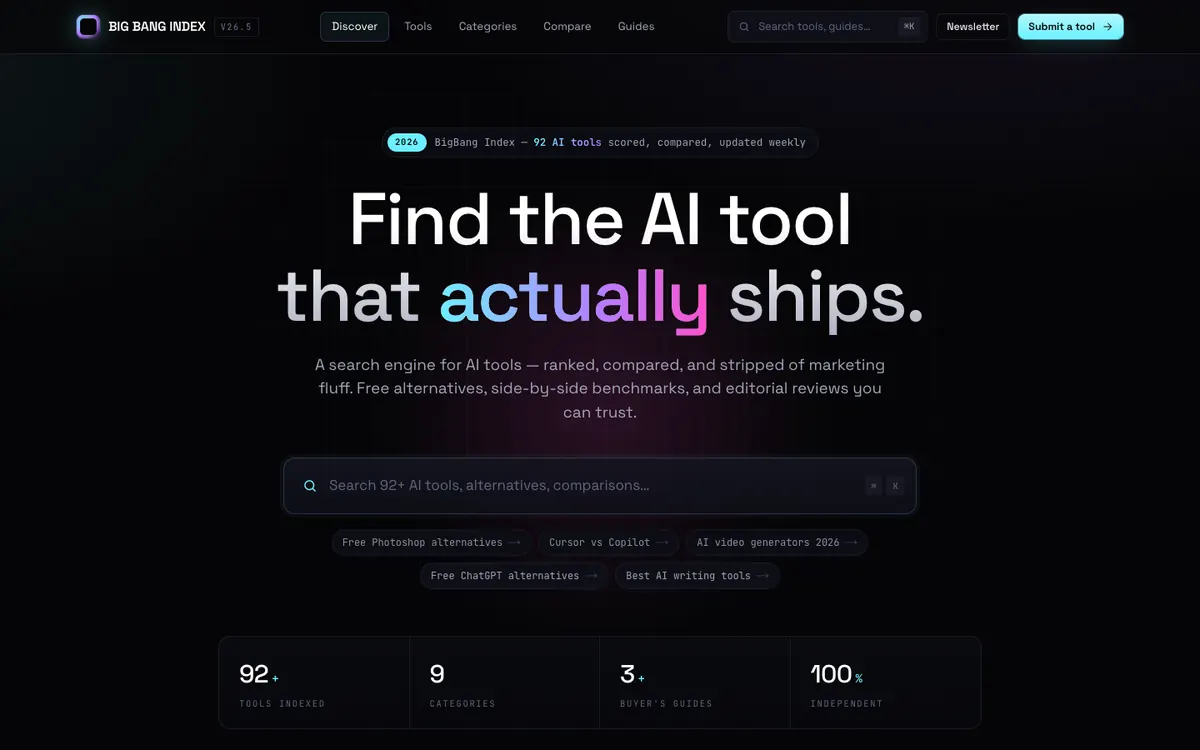
- AI tools scored on one published rubric
- 92
- head-to-head comparisons
- 50
- from first commit to MVP 1.0
- 6 wks
- Lighthouse SEO and Best Practices
- 100
The brief
A directory you can trust.
Most AI tool directories are long lists ranked by who paid or who launched last. We wanted the opposite: every tool judged on the same visible rubric, pages fast enough to feel instant, and content structured so search engines and AI assistants can quote it accurately.
It also had to run without a team. One person writes, scores and ships, so every recurring job either became part of the build or got cut.
What we built
Six pieces that do the work.
A score you can audit
Every tool gets a BigBang Score from 0 to 100: the sum of seven weighted sub-scores, computed at build time from the tool's own data file. The weights and the testing method are published on the site, so a reader can check why one tool outranks another.
Content as code, no runtime database
Each tool, category and guide is a JSON file in git. Pages are pre-rendered at build, so a visitor never waits on a database query, and every content change is reviewable and reversible like any code change.
Search that feels instant
A command palette (Cmd+K) searches tools, categories and guides from an index generated at build time. It loads on first use, so it costs nothing on pages where nobody searches.
Built to be read by machines
Every page type ships structured data: SoftwareApplication for tools, FAQPage, BreadcrumbList and ItemList where they apply, plus an llms.txt for AI crawlers. An internal audit page scores every public page for SEO and answer-engine readiness.
Forms that only succeed when a human gets the lead
Newsletter and tool-submission forms are validated, honeypot-protected and delivered straight to Telegram. The form reports success only when the message actually arrives. Nothing is stored that does not need to be.
A build that refuses to ship broken links
A post-build check fails the deploy if any page links to a comparison that no longer exists, so a content cleanup can never leave dead links live.
Decisions that mattered
Cut more than we added.
- Quality over volume. Programmatic comparison pages grew to around 590. We cut them to the 50 that answer a question people actually ask, and the removed URLs return proper status codes instead of thin pages.
- Every public page had to clear 70 on both the SEO and answer-engine audits before MVP 1.0 shipped. All 117 pages did, averaging 90 and 78.
- A full SEO audit in July halved page weight and found the host's CDN caching HTML for a year, which served stale pages with broken styles after every deploy. Fixed at the header level, with a short edge cache instead.
Stack
Boring where it should be.
- Next.js 16
- React 19
- TypeScript
- Tailwind CSS
- JSON content in git
- Cloudflare
Lighthouse on the live homepage, October 2026: SEO 100, Best Practices 100, desktop performance 97.
Visit bigbangindex.comRead the scoring method
Ready to start?Want this level of care on your build?
Fixed scope, fixed price, and you own everything we ship.